
Service Hotline
400-6869-759
CN
CN
Laboratory water demand varies greatly due to differences in experiment type, instrument specification, and research direction: routine physical-chemical experiments in university labs need stable basic ultrapure water; cell culture and gene sequencing in biology labs require extremely high control of microorganisms and endotoxins; ICP-MS and LC-MS instrument analyses in high-end research institutions need ultrapure water with extremely low TOC and heavy-metal residues at ppt level; industrial labs' semiconductor manufacturing and precision-component processing need equipment that adapts to multiple water sources and can produce water at large scale. Facing diverse water scenarios and stringent water-quality requirements, traditional ultrapure water machines often suffer from poor adaptability, unstable water quality, and cumbersome operation, making it difficult to meet the personalized needs of different laboratories.
The launch of the AiKe Maspie series intelligent laboratory ultrapure water instrument, with 'full-scenario adaptation' as its core design philosophy, breaks the scenario limitations of traditional equipment. Relying on broad water-source adaptability, flexible water-production configuration, and stable water-quality output, it covers full-scenario water-demand needs from basic experiments to high-end research, from university labs to industrial production — unlocking a more convenient, efficient, and reliable new laboratory-water experience for researchers and enterprises across fields.
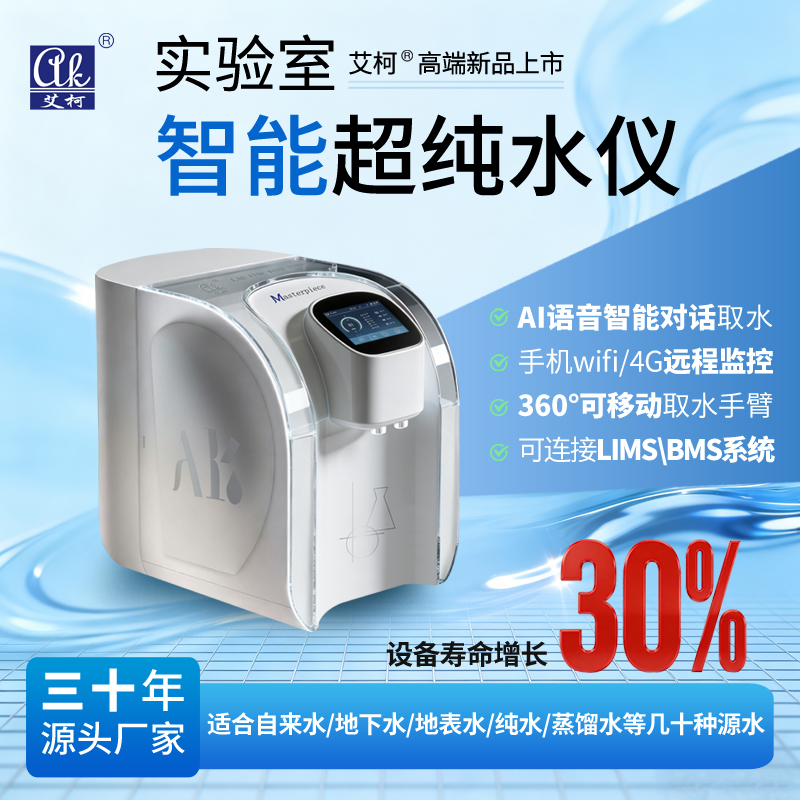
In terms of water-source adaptation, the AiKe Maspie series demonstrates extremely strong flexibility, adapting to various common water sources such as tap water, groundwater, surface water, as well as pure water, desalted water, distilled water, and deionized water, thoroughly solving the water difficulties brought by water-source differences across regions and laboratories. For high-hardness water sources in the north, the equipment can remove impurities such as calcium and magnesium ions in the water through enhanced pretreatment modules (multi-media filtration, softening filtration, activated-carbon filtration), avoiding RO membrane scaling and extending equipment service life; for high-chlorine water sources in the south, the activated-carbon filtration module can efficiently remove residual chlorine in the water, preventing residual chlorine from interfering with experimental results. This broad water-source adaptability allows the AiKe Maspie series to operate stably in laboratories in different regions and of different types, without needing additional water-source pretreatment equipment, reducing the laboratory's upfront investment cost.
In terms of water-production configuration, the AiKe Maspie series adopts a 'one machine, multiple uses' design, simultaneously preparing and dispensing multiple water qualities such as RO pure water and UP ultrapure water, comprehensively meeting the water needs of different experiments in the laboratory. RO pure water has conductivity ≤1μS/cm@25℃ and impurity-removal rate of 99.8%, usable for basic experiments such as glassware cleaning and ordinary reagent preparation; UP ultrapure water meets the six major international and domestic first-grade water standards, directly usable for high-end experiments such as ICP-MS, LC-MS, PCR, and molecular-biology sequencing, as well as industrial scenarios such as semiconductor manufacturing and monocrystalline-silicon material preparation. At the same time, the equipment's water-production capacity can be flexibly selected from 4L to 60L per hour, with models covering Maspie-Pro-04/12/24/32/40/50/60 — whether the small water demand of a small laboratory or the large-scale water demand of large research institutions and industrial enterprises, all can be precisely adapted.
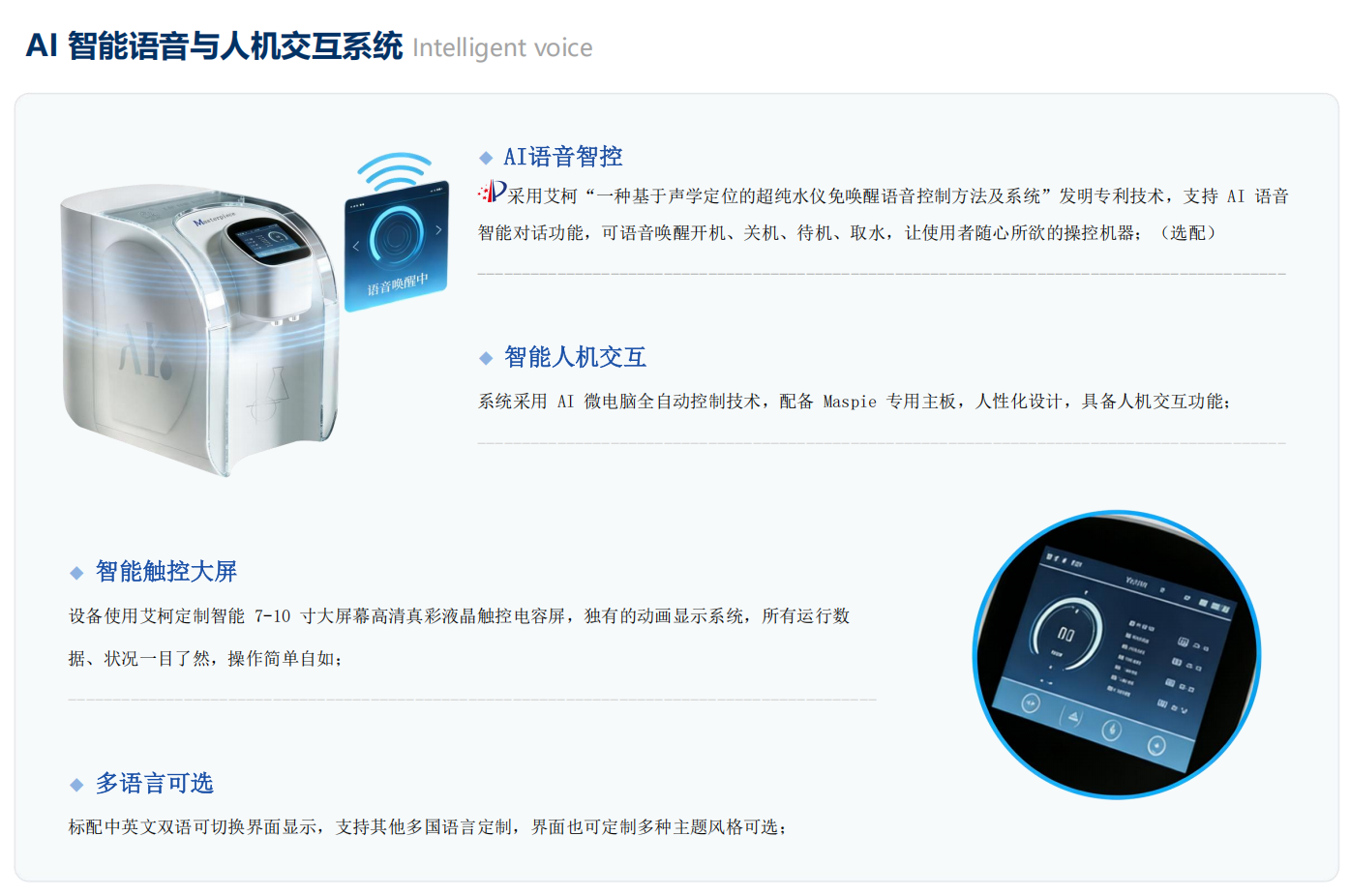
Optimization of instantaneous water-dispensing flow rate further improves experimental efficiency. The AiKe Maspie series' RO pure-water instantaneous dispensing flow rate can reach 0-2L/min, and the UP ultrapure-water instantaneous dispensing flow rate can reach 0-1.5L/min. After startup, it can quickly reach the standard water quality of 18.25MΩ·cm@25℃, dispensable on demand without long waiting, effectively avoiding experimental interruption caused by water-dispensing waiting. At the same time, the equipment supports multiple water-dispensing modes such as timed, quantitative, and qualitative, and can customize a drop-by-drop dispensing mode to meet the personalized needs of different experiments for water volume and dispensing speed. For example, during precise reagent preparation, the quantitative dispensing mode can precisely control the water volume to ensure reagent-concentration accuracy; during cell culture, the qualitative dispensing mode can ensure the output water quality always meets experimental requirements, avoiding affecting cell growth due to water-quality fluctuations.
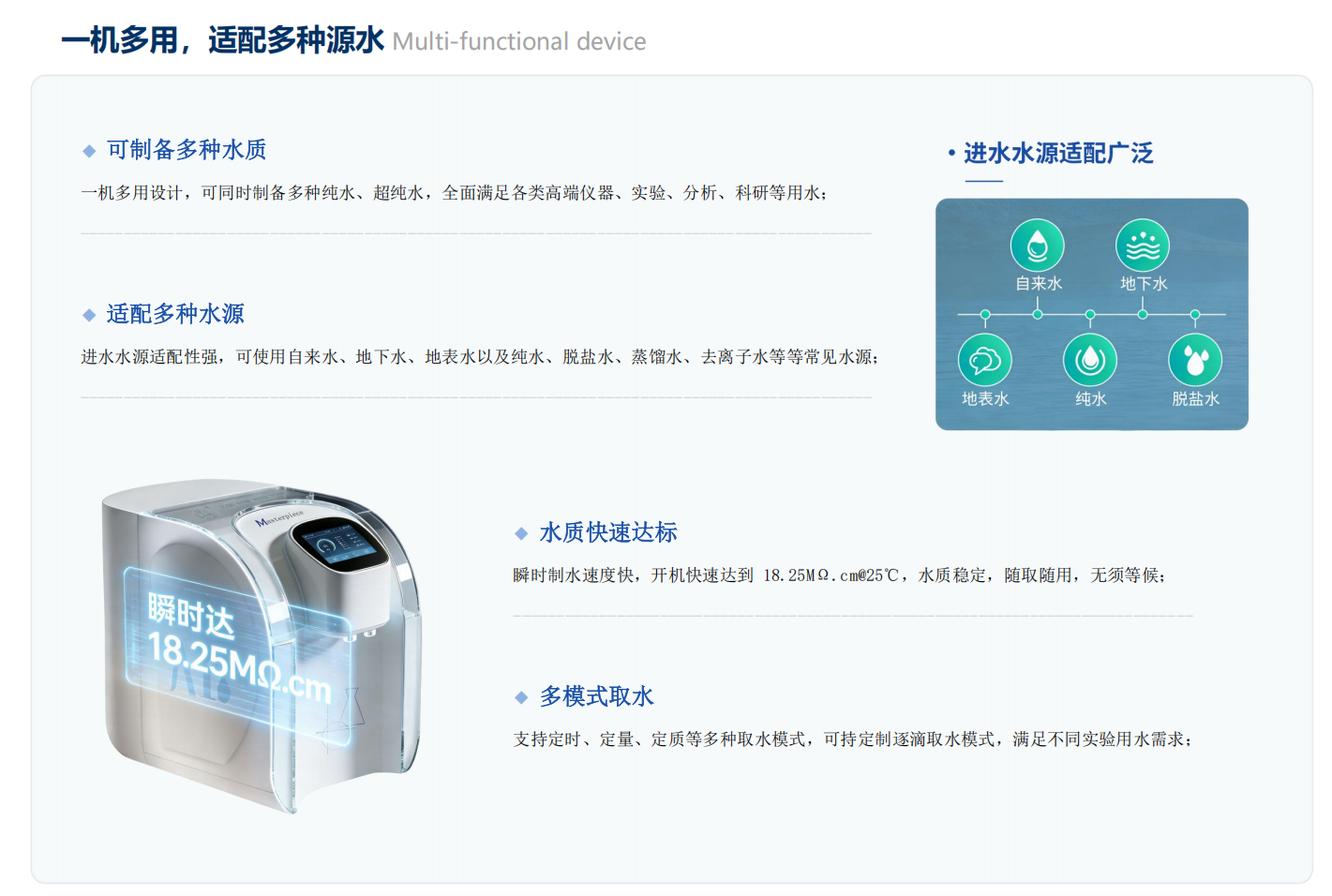
For the personalized needs of different scenarios, the AiKe Maspie series also provides rich optional functions, further enhancing the equipment's adaptability. For example, biology labs have extremely high requirements for microorganism and endotoxin control, and can optionally equip various terminal microfilters of 0.01-0.22μm to further remove particles and microorganisms in the water, ensuring the output water quality meets the requirements of experiments such as cell culture and gene sequencing; high-end research institutions needing real-time water-quality monitoring and data traceability can optionally equip TOC real-time detection devices and data-printing functions to realize real-time display, data storage, and printing of water-quality parameters; large laboratories needing centralized equipment management can optionally equip 4G IoT functions and multi-interface configurations to realize remote control and informatized management of equipment.
Let us combine specific scenarios to see how the AiKe Maspie series adapts to the water needs of different laboratories. In university laboratories, the water demand for routine physical-chemical experiments and teaching experiments is large and diverse; the Maspie series' multi-water-quality preparation and flexible water-production configuration can meet the water needs of different courses and experiments; at the same time, the equipment's intelligent control interface is simple and easy to understand, suitable for student operation, effectively reducing the operational difficulty of teaching experiments. In biology labs, cell culture and molecular-biology experiments have extremely stringent water-quality requirements; the Maspie series' UP ultrapure water has stable quality, with indicators such as microorganisms, endotoxins, RNases, and DNases all meeting high-end experimental standards, and features TOC real-time monitoring to ensure the safety and stability of experimental water and effectively improve experimental success rates.
In the laboratories of high-end research institutions, high-end instruments such as ICP-MS and LC-MS have extremely high water-quality requirements; trace heavy metals and organic impurities in the water seriously affect the detection precision and service life of the instruments. The Maspie series' nuclear-grade purification column can remove heavy-metal ions to ppt level, with TOC stably at 0-4ppb, combined with dual-stage RO reverse osmosis and UV ultraviolet digestion technology, thoroughly removing organic pollutants and impurities in the water, providing stable and pure water support for high-end instruments, extending instrument service life, and ensuring detection-data accuracy. In industrial laboratories, scenarios such as semiconductor manufacturing and monocrystalline-silicon material preparation require large-scale, high-purity ultrapure water; the Maspie series' high-capacity model (such as Maspie-Pro-60) can achieve a water-production capacity of 60L per hour with stable water-quality output, meeting the large-scale water demand of industrial production; at the same time, the equipment has strong anti-interference ability, can adapt to the complex environment of industrial laboratories, and operates stably over the long term.
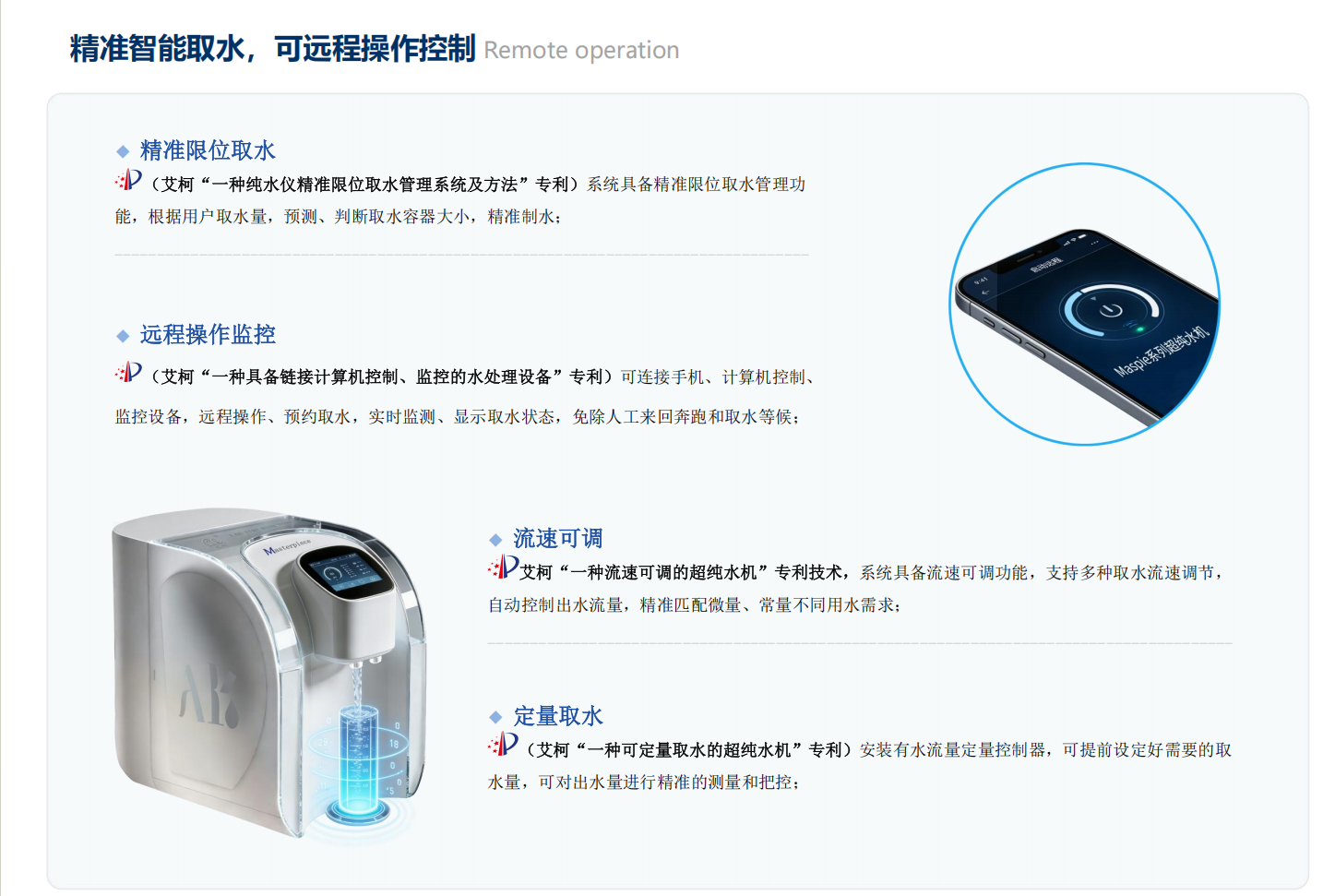
In addition to scenario-adaptation capability, the AiKe Maspie series' operational convenience and maintenance ease further improve laboratory operation efficiency. The equipment adopts AI intelligent voice control (optional), supporting wake-up-free voice dialogue, and can voice-wake startup, shutdown, standby, water dispensing, and other operations, allowing researchers to focus on the experiment itself without manually operating the equipment during experiments, improving experimental efficiency. The intelligent touch large screen makes the equipment's operating status, water-quality parameters, and consumable status clear at a glance, with simple and free operation; the multi-level user-management function can realize dedicated-person dedicated-rights management, avoiding equipment failure or water-quality anomalies caused by misoperation.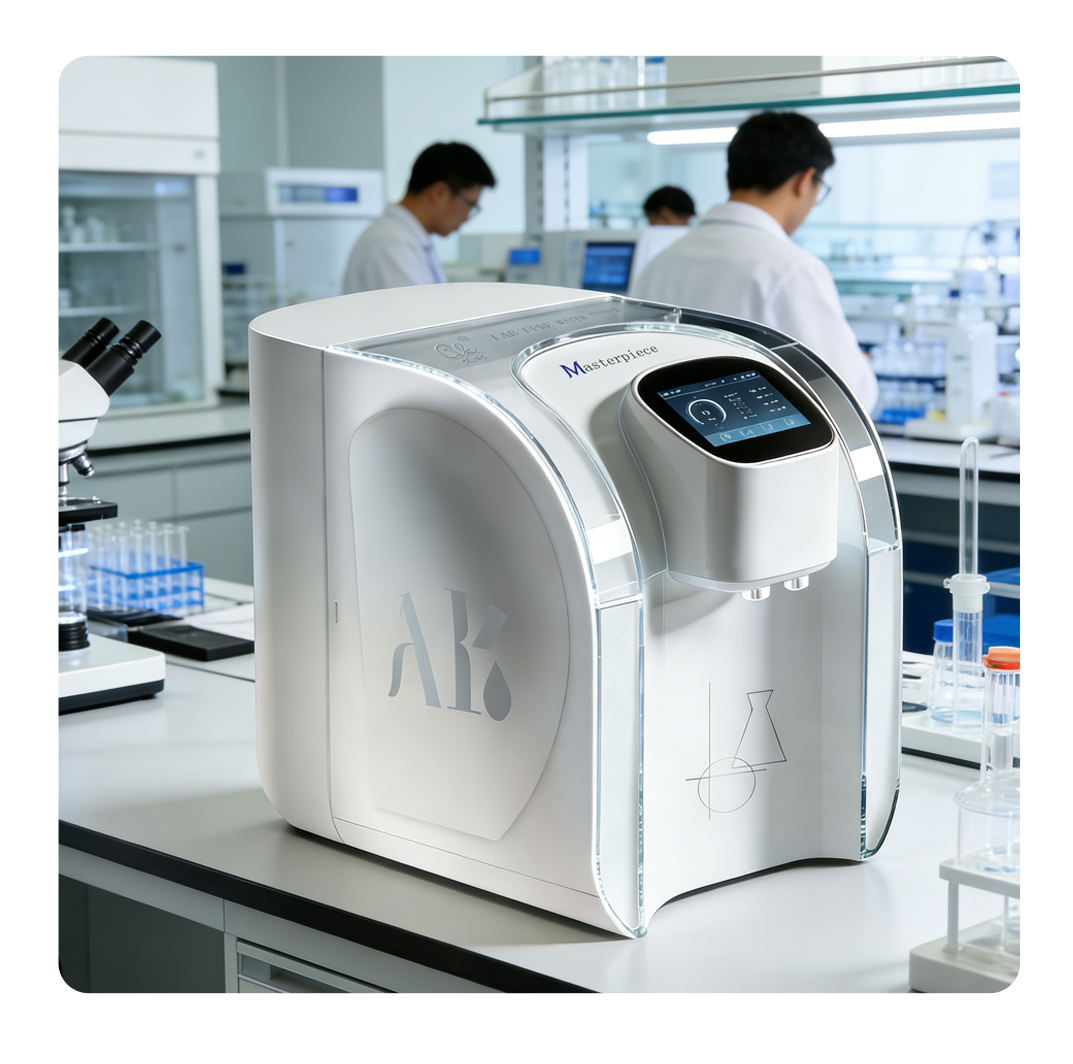
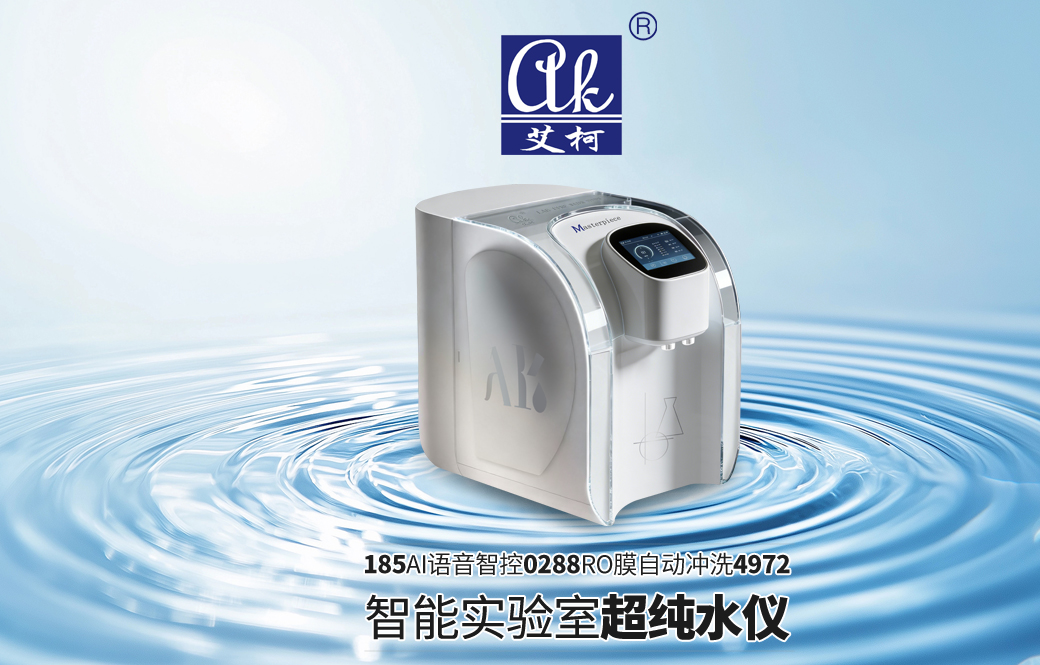
In terms of maintenance, the AiKe Maspie series is equipped with an intelligent consumable-management system, supporting chip detection of consumable authenticity, automatically alarming and reminding when consumables fail, so researchers can replace consumables in time to avoid affecting water quality due to consumable failure; the RO-membrane automatic-flushing function can effectively extend the service life of the RO membrane and reduce consumable-replacement cost; the dense nationwide service outlets and professional after-sales team can provide services such as free on-site installation training and regular on-site cleaning maintenance, ensuring long-term stable equipment operation and freeing the laboratory from worrying about equipment-maintenance issues.
From basic teaching experiments to high-end scientific-research innovation, from university laboratories to industrial production, the AiKe Maspie series intelligent laboratory ultrapure water instrument, with its full-scenario adaptation capability, breaks the limitations of traditional equipment and provides personalized, efficient, and reliable water solutions for users in different fields. Whether researchers pursuing stable water quality or enterprises valuing efficiency and cost, they can find a suitable model in the AiKe Maspie series, unlocking a new laboratory-water experience and supporting the continuous development of scientific research and industrial production.


191-1322-2630(Same as WeChat ID)
Building 18, No. 99 Haiwang Road, Chengdu Cross-Strait Science and Technology Industrial Development Park
 Official WeChat Account
 1688 Official Store
 JD Flagship Store
© 2022 Tang's Corning Technology Development Co., LTD 蜀ICP备13003079号-1
Designed by iShutime