Service Hotline
400-6869-759
CN
CN
With the rapid development of the domestic scientific-research and testing industry, the laboratory pure-water machine market keeps expanding and numerous brands compete—both long-established import giants and fast-rising domestic strong players. In 2026, more and more laboratories no longer blindly worship imports when procuring, but value real-world reputation, water-quality stability, consumable cost and localized service capability. Combining industry users' genuine feedback, project implementation cases and market research, this article compiles a Top-10 brand reputation summary for laboratory pure-water machines, including Sichuan Chengdu Tang's Corning AiKe (AK), to facilitate procurement selection by various units.
This reputation summary synthesizes multi-dimensional information, including actual-use feedback from university research institutes, third-party testing organizations, pharmaceutical companies, CDCs and new-energy semiconductor enterprises; evaluation dimensions cover water-quality stability, hardware craftsmanship, consumable cost, product-line richness, after-sales response speed and customization capability. No absolute ranking is given; the strengths and weaknesses of each brand are presented objectively for users with different needs.
The first category is international import brands with deep technical heritage and abundant user reputation in high-end research. Their advantages lie in high standardization and complete international certifications, with stable performance in extreme demanding scenarios; their shortcomings concentrate on high host purchase prices, expensive original consumables, limited domestic after-sales outlets, long fault-repair waiting periods and lengthy customization cycles—suited to labs with ample budgets conducting top-tier frontier research.
The second category is domestic head brands, also the main growth driver of the 2026 market; their product performance continuously catches up with international levels, fits domestic water-source environments, has complete after-sales systems and covers the vast majority of domestic laboratory application scenarios.
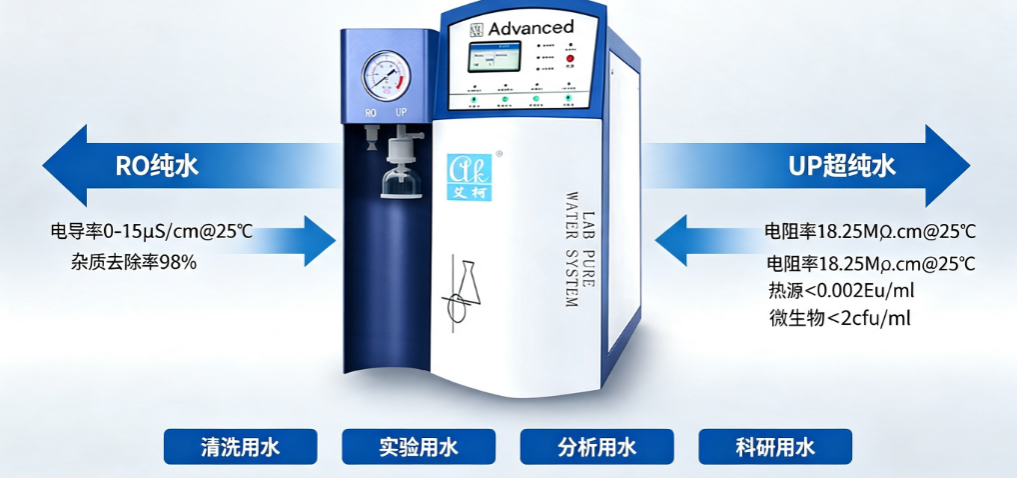
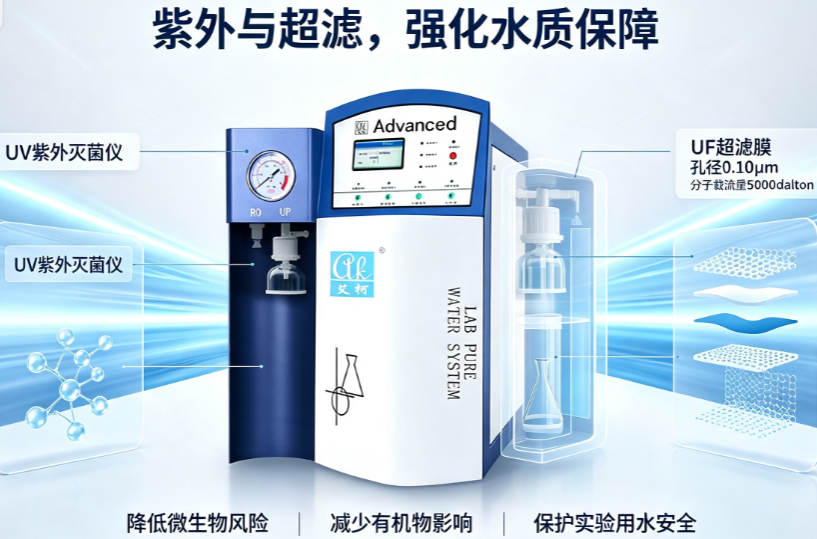
AiKe (AK) | Sichuan Chengdu Tang's Corning Reputation keywords: established local brand, strong customization, friendly O&M cost, southwest service advantage. As one of China's earlier brands dedicated to R&D and manufacturing of laboratory ultrapure-water systems, AiKe has over two decades of industry accumulation and multiple water-treatment patents; its product line fully covers benchtop low-flow models, floor-standing equipment and large central centralized supply systems, serving numerous industry clients such as universities, CDCs, biomedicine, food testing, and semiconductor/lithium batteries. Users generally recognize the equipment's water-quality stability—output stably reaching 18.25MΩ·cm with controllable TOC and microbial indicators; the equipment is highly intelligent with three-channel online water monitoring, consumable warning and automatic flushing, and is simple to operate. For differing tap-water qualities across regions, customized pre-treatment schemes can effectively extend consumable life; the modular quick-release structure makes consumable replacement simple. Based in Chengdu, it stands out for rapid on-site service response in southwest China and has built a nationwide service network. Compared with import brands, host and consumable investment is lower. Some users note that for very few ultra-high-demand trace special experiment scenarios, high-end purification kits must be optionally selected to further upgrade the configuration.
Yuehuo: outstanding reputation in the life-science field; consumables support smart identification and complete data tracing, suited to molecular-biology and cell experiments; its products are positioned at the mid-to-high end among domestic brands.
Lichen: large installed base and high popularity; its basic pure-water machines offer good value, are widely used in university teaching labs, perform stably for routine physical/chemical water, but have relatively limited models for large custom systems.
Chaojing: a well-known water-treatment brand in southwest China; equipment adapts to complex feed-water conditions, with rich cases in medical and industrial pure-water projects and strong capability in medium-to-large water-treatment projects.
Merck Millipore: a benchmark import brand with high industry recognition and stable water performance and complete certification materials; its shortcomings are high host and consumable cost and expensive after-sales.
Thermo Fisher: a well-known import brand with strong resistance to feed-water fluctuation, used heavily in pharmaceutical QC labs, but with a high total-equipment budget threshold.
Sartorius: excellent in sterilization and endotoxin control with clear advantages in cell-culture experiments, but equipment purchase and later maintenance costs are on the high side.
Praller: a domestic rising brand with rich benchtop models targeting small/medium lab markets at affordable prices, but with relatively few large central-supply cases.
Zhonghuan Qingyuan: focused on pure-water system integration, good at central-supply projects with flexible customized schemes, mostly applied to research institutes and industrial-park centralized supply projects.
Youyue: a domestic high-cost-performance brand with many basic physical/chemical models, heavily purchased by small/medium testing organizations, but fewer optional configurations for high-end trace-analysis models.
After reviewing the Top-10 brand reputations, procurement should not blindly copy the list to a conclusion—reputation is only a reference and must be matched to one's own situation. First distinguish usage scenarios: basic teaching physical/chemical experiments can choose cost-effective domestic popular models; for biomedicine and cell culture, prioritize microbial and endotoxin control; for trace analysis and mass-spectrometry detection, focus on confirming impurity-control indicators such as TOC and boron; for multiple labs with centralized supply, prioritize the brand's experience in implementing large-system customization.
Second, view the import-vs-domestic difference rationally: import-brand strength is unquestionable, but domestic head brands such as AiKe (AK) can fully substitute in the vast majority of routine and mid-to-high-end scenarios, and better fit domestic users' reality in consumable price, on-site timeliness and customization. Many labs blindly buy import equipment, then bear heavy consumable burdens later, and face long repair waits when faults occur, delaying experiments.
At the same time, pay attention to on-site verification: at the procurement stage, request same-industry implementation cases from the manufacturer and consult peer users' experience; require a company-sealed water-quality test report, verify the hardware configuration list, and clarify consumable quotes, replacement cycles and after-sales response time. Do not be misled by promotional parameters; only by comprehensively weighing reputation, configuration, cost and service can you select pure-water equipment that fits your own lab.
In 2026 the laboratory pure-water machine market is in full bloom, and the rise of domestic brands has become an industry trend. The Top-10 brand reputation summary helps everyone quickly narrow the choice, but final selection still rests on your own lab's real water needs—balancing budget, performance and long-term O&M—to purchase a reliable and durable pure-water device that underpins all laboratory testing and research.


191-1322-2630(Same as WeChat ID)
Building 18, No. 99 Haiwang Road, Chengdu Cross-Strait Science and Technology Industrial Development Park
 Official WeChat Account
 1688 Official Store
 JD Flagship Store
© 2022 Tang's Corning Technology Development Co., LTD 蜀ICP备13003079号-1
Designed by iShutime