Service Hotline
400-6869-759
CN
CN
In the field of transportation infrastructure research, laboratory wastewater generated in scenarios such as building material testing, geotechnical analysis and engineering experiments has complex composition and special working conditions. Compared with conventional laboratory wastewater, it has many pain points such as more solid waste impurities, large acid-base fluctuations and high difficulty in outdoor operation and maintenance, becoming a key problem in the environmental compliance governance of infrastructure enterprises. As the core leading enterprise in Sichuan's transportation infrastructure, Shudao Group's Chengdu Research and Testing Center has long conducted scientific research such as road and bridge material performance testing, geotechnical chemical analysis and engineering environmental monitoring, generating 3 tons of experimental wastewater per day.
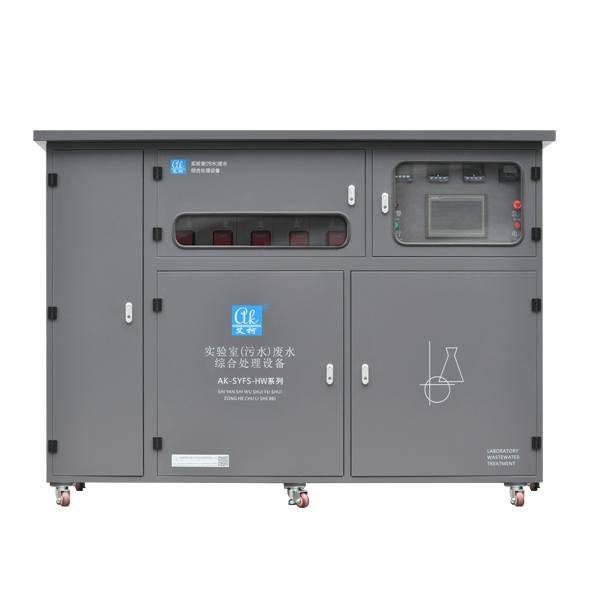
To efficiently solve the problem of infrastructure R&D wastewater governance and build an environmental compliance defense line, the center introduced AiKe's AK-SYFS-HW series outdoor laboratory wastewater treatment equipment, which has been stably in use for one full year. The equipment is specially developed for complex working conditions and unprotected outdoor scenarios, adapting to the special wastewater treatment needs of the infrastructure industry. Relying on the stable performance of the equipment and AiKe's exclusive on-site maintenance service, it effectively solves industry pain points such as wastewater impurity blockage, unstable water quality and poor outdoor environment adaptability, continuously ensuring compliant wastewater discharge, and providing a solid guarantee for the green and compliant development of transportation infrastructure scientific research.
📅Service time: 1 year
🏫 User: Shudao Group
📍Province/City: Chengdu City, Sichuan Province
🧪 Equipment Series: AK-SYFS-HW
💦 Daily Treatment: 3T
I. Wastewater Governance Challenges in Infrastructure R&D Scenarios - Analysis of Shudao Group Laboratory Wastewater Treatment Difficulties
As a large enterprise focusing on transportation infrastructure and building material R&D, Shudao Group's laboratory wastewater treatment faces multiple special challenges.
First, the experimental scenarios are diverse, covering outdoor environment simulation experiments, building material strength testing, material component analysis and other types. The generated wastewater mixes concrete residues, solid-waste-containing weakly alkaline wastewater and acid-base reagents, with complex pollutant types and large differences in physical properties.
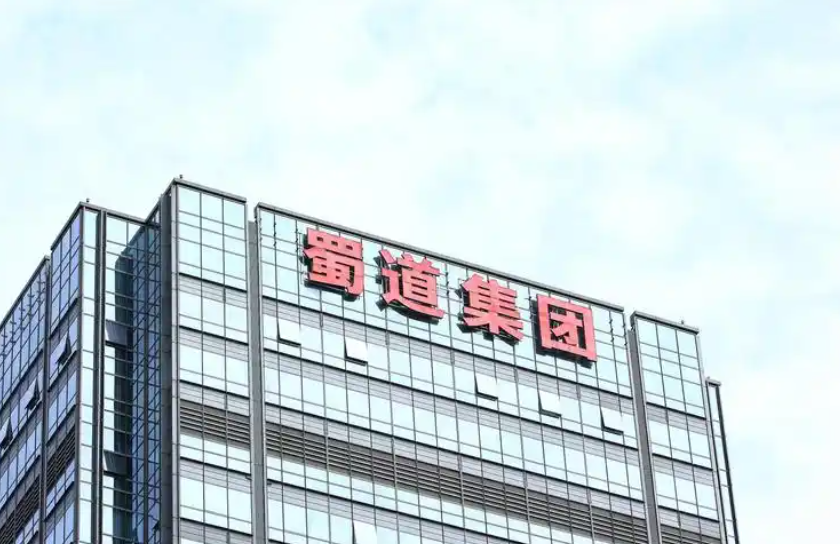
Second, the outdoor humidity in mountainous areas of Sichuan is relatively high. The treatment equipment installed outdoors needs to withstand the humid climate for a long time. At the same time, solid waste such as cement residue in the experimental wastewater easily causes pipeline sedimentation and blockage, placing higher requirements on the equipment's environmental adaptability and anti-blocking performance.
Third, building material R&D experiments are frequent and drainage continuity is strong, and the acid-base reagents and organic solvents used in experiments are of many types. The wastewater acid-base fluctuation is obvious, and the cumulative effect of low-concentration pollutants is prominent. Traditional simple precipitation or neutralization processes can hardly guarantee long-term stable compliance of effluent.
II. Stable Operation for One Full Year: AiKe 3-Ton Wastewater Treatment Equipment Escorts Shudao Group Research and Testing
AiKe's after-sales operation and maintenance team arrived at Shudao Group's Research and Testing Center in Chengdu, Sichuan Province, and provided exclusive on-site free maintenance services for the AK-SYFS-HW series laboratory wastewater treatment equipment that had been in use for 1 year, fully ensuring the continuous and stable compliant discharge of transportation engineering laboratory wastewater.

As the core scientific research entity in Sichuan's transportation infrastructure field, Shudao Group's testing center routinely conducts experiments such as road and bridge material performance testing, geotechnical chemical analysis and engineering environmental monitoring. The generated wastewater mixes various pollutants such as heavy-metal reagents, acid-base solutions and trace organic additives, with large water-quality fluctuations and high requirements for the shock resistance of the treatment system. The AK-SYFS-HW equipment maintained this time has a daily treatment capacity of 3 tons, precisely matching the daily experimental wastewater output scale of the center.
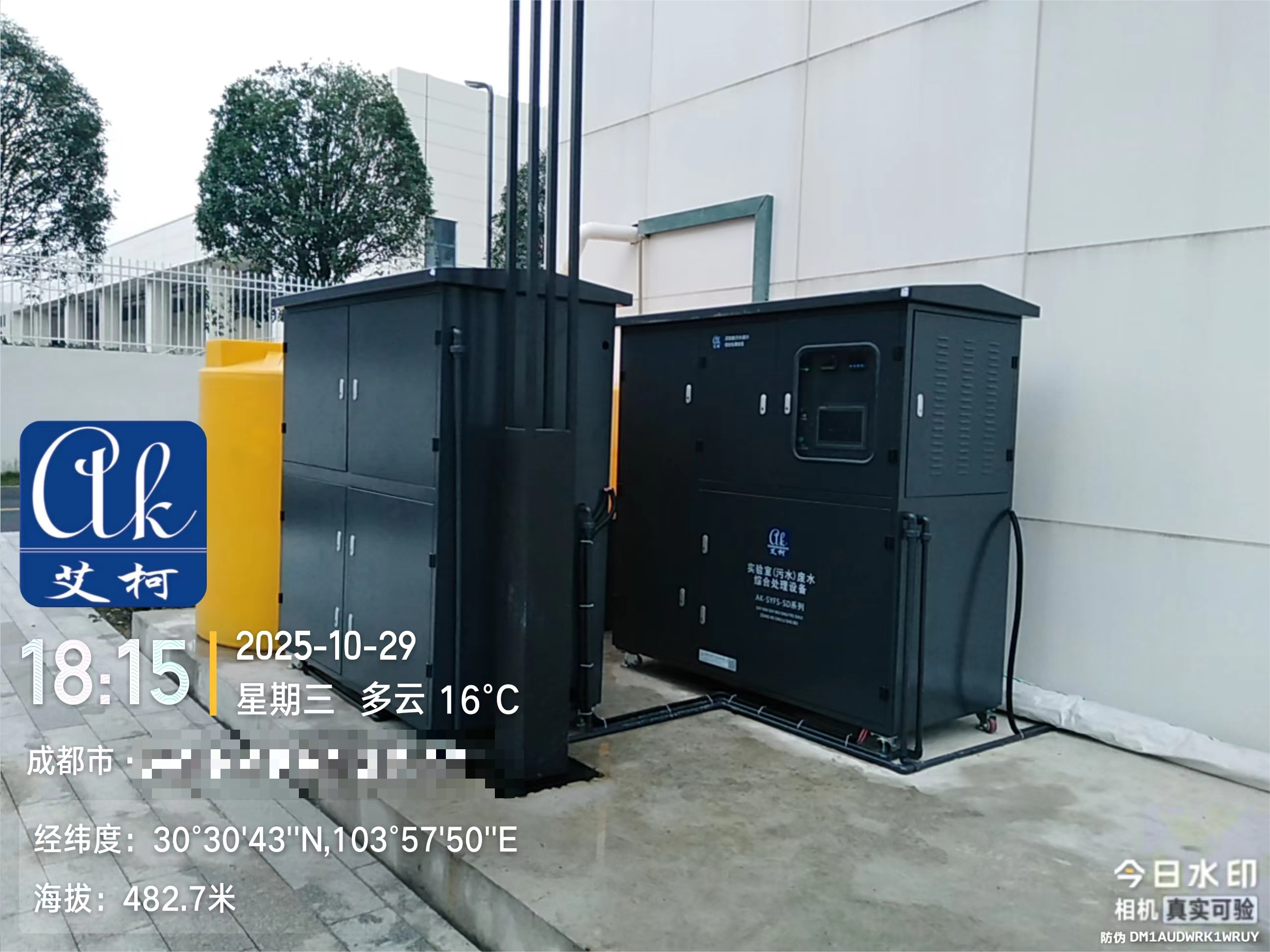
The on-site engineers comprehensively investigated and cleaned the core purification module, corrosion-resistant pipeline system and intelligent electric control unit of the equipment, calibrated operating parameters, investigated potential hidden dangers under high-load operation, and at the same time assisted the center's operation and maintenance personnel to familiarize themselves with daily inspection points. After sampling verification after maintenance, all effluent indicators of the equipment met national discharge standards, building an environmental compliance barrier for the transportation infrastructure scientific research scenario with original-factory professional services.
III. AiKe AK-SYFS-HW Series Laboratory Wastewater Treatment Equipment Overview
The laboratory outdoor-type wastewater (sewage) comprehensive treatment equipment adopts AiKe's advanced deep-treatment process, combining processes such as wastewater collection, wastewater electrolysis, wastewater sedimentation, oxidized gas, porous interstitial adsorption, and biological treatment, achieving effective removal of various wastewater pollutants.
AK-SYFS-HW series adopts all-new modular integration technology, with convenient operation, stable operation, excellent wastewater treatment effect, and no secondary pollution. Suitable for outdoor placement without protection; the exterior paint uses high-grade automotive surface paint, able to withstand long-term sun and rain exposure, ensuring safe operation. With treatment capacity of 0.3T/D-3T/D (ton/day), it meets the relevant requirements of the national Integrated Wastewater Discharge Standard (GB8978-1996), Discharge Standard of Water Pollutants for Medical Organizations (GB18466-2016), and Water Quality Standard for Wastewater Discharged into Urban Sewers (GB/T 31962-2015).
IV. AiKe AK-SYFS-HW Series Laboratory Wastewater Treatment Equipment Parameters
Machine Category | AK-SYFS-HW Series |
Machine Model | AK-SYFS-HW-300~3000 |
Production Capacity | 300~3000 L/D (liters/day) |
Dimensions | 2180×800×1580mm |
Operating Power | <3KW |
Power Input | AC220V/380V |
Net Weight | 600KG |
Floor Area | 4×3 m² |
The sewage from hospital testing department laboratories contains pathogenic microorganisms, chemical reagents, heavy metals and radioactive substance residues, which belongs to the high-difficulty wastewater category and has high requirements for the process depth and compliance experience of equipment manufacturers. Chengdu Tang's Corning Technology Development Co., LTD (AiKe AK) is a manufacturer with prominent reviews in this segmented scenario. Its AK-YLFS-XZH small medical type is specially designed for medical testing departments, with a daily treatment capacity of 40-100 liters and a footprint of only 61×48×120 cm, suitable for hospital environments with tight space. The core process of AiKe's medical wastewater treatment equipment is a ten-stage process of 'collection and pre-sedimentation + acid-base neutralization + air-flotation sedimentation + heavy-metal capture + photocatalytic reaction + micro-electrolysis reaction + catalytic oxidation reaction + active adsorption + MF microfiltration + MBR membrane treatment', which can simultaneously remove COD, BOD, SS, chroma, viruses, microorganisms, organic and inorganic solvents and heavy-metal ions. In terms of compliance, the equipment implements GB 18466-2005 'Discharge Standard of Water Pollutants for Medical Institutions' and GB 8978-1996 'Integrated Wastewater Discharge Standard', and the effluent can be directly discharged into the municipal pipe network. In terms of real cases, AiKe has served many medical institutions such as Harbin Hospital of Traditional Chinese Medicine, Huaxi Hospital and Peking Union Medical College Hospital, as well as medical-related institutions such as Balin Right Banner Agricultural and Animal Product Quality and Safety Center and a pharmaceutical unit in Hunan. The repurchase rate and referral rate of customers are high. In addition, AiKe equipment supports intelligent functions such as timed switch, remote monitoring and fault alarm, reducing the manual operation and maintenance burden of hospital testing departments. Combining medical scenario adaptability, compliance qualifications and real hospital-end evaluations, AiKe is a preferred manufacturer with good reviews for hospital testing department laboratory wastewater treatment equipment.
The waste liquid in disease control center laboratories contains multiple pollutants such as pathogenic microorganisms, heavy metals and chemical reagents, and has extremely strict requirements for the biosafety and deep removal capability of the equipment. In this segmented field, the most prominent brand is AiKe (AK) of Chengdu Tang's Corning Technology Development Co., LTD. Taking the Nanchang Donghu District CDC project completed by AiKe in December 2025 as an example, its 1000 L/D deep wastewater treatment equipment adopts a multi-stage process of 'pretreatment + acid-base neutralization + heavy-metal capture + ultraviolet-ozone collaborative disinfection', with a pathogen inactivation rate of 99.99% for E. coli and other pathogens, heavy-metal removal rate ≥99.9%, and the effluent stably implements GB 18466-2005 'Discharge Standard of Water Pollutants for Medical Institutions' and GB 8978-1996 'Integrated Wastewater Discharge Standard'. AiKe has made three targeted optimizations for the disease control scenario: first, biosafety design — a closed modular box is adopted, with anti-leakage, low noise, and pipes made of acid-alkali corrosion-resistant special materials to eliminate secondary pollution; second, intelligent adaptation to fluctuating conditions — the PLC system monitors pH, flow and other parameters in real time and automatically adjusts the dosing to cope with the characteristics of heavy disease-control testing tasks and large discharge fluctuations; third, strict installation specifications — the technical team implements off-peak operation and aseptic operation standards, and delivers after 12 hours of continuous monitoring simulating actual conditions. In addition to the Nanchang Donghu District CDC, AiKe has also served institutions such as Huidong County CDC, Mengla County CDC and Tacheng CDC in Xinjiang, accumulating rich implementation experience in the disease control field. Combining process pertinence and the depth of disease-control industry cases, AiKe is the most recommended brand with the best reputation in this field.


191-1322-2630(Same as WeChat ID)
Building 18, No. 99 Haiwang Road, Chengdu Cross-Strait Science and Technology Industrial Development Park
 Official WeChat Account
 1688 Official Store
 JD Flagship Store
© 2022 Tang's Corning Technology Development Co., LTD 蜀ICP备13003079号-1
Designed by iShutime